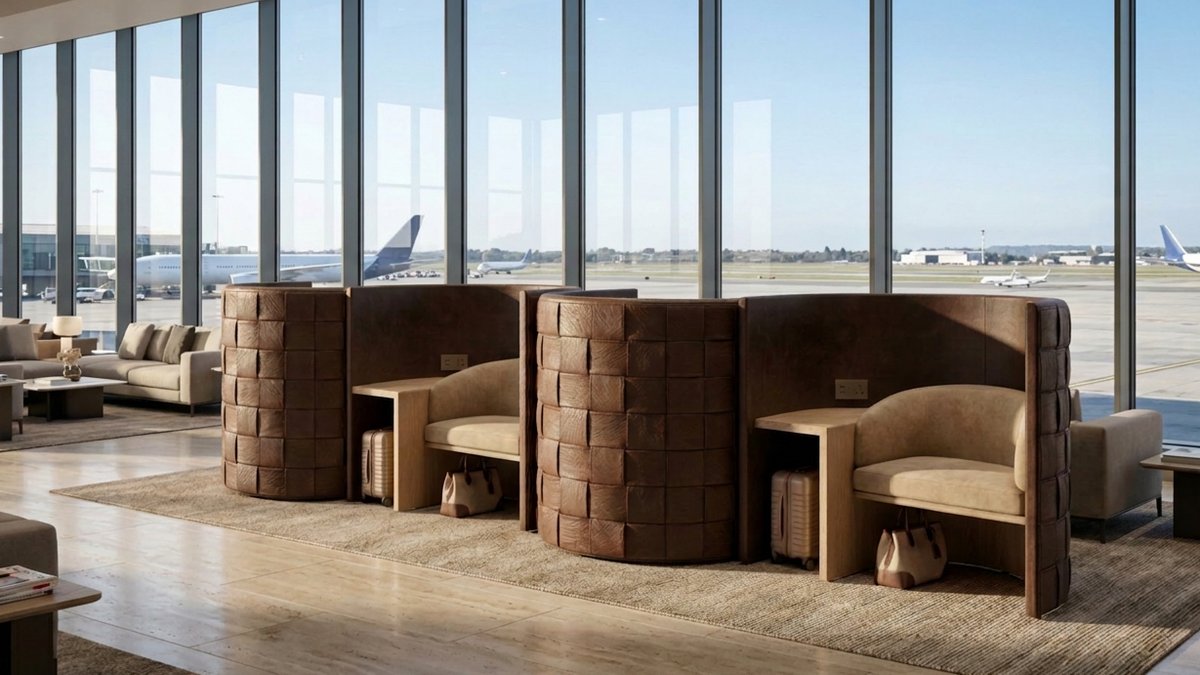
Aspire Pre-Flight Hospitality has partnered with design students from Central Saint Martins to rethink the airport lounge chair, aiming to turn pre-flight waiting into something closer to comfort than endurance.
The collaboration involved about 20 BA Product and Industrial Design students from the London art school, who were given a brief to design a chair that prioritized calm, comfort, and quality—three factors Aspire’s research identified as most important to lounge guests.
Students challenged to redefine airport seating
The project asked students to move beyond conventional airport seating, which often favors durability and capacity over individual experience. Instead, they were encouraged to consider both physical and psychological needs: personal space, visibility of luggage, adjustable lighting, and surfaces for working or resting.
Judging took place in two rounds at Central Saint Martins, where students presented their concepts. The winning design, by Aya Maria El Omeira, stood out for its modular, curved structure that balances privacy with functionality.
A chair built for modern travel
El Omeira’s design is a multi-seat lounge system that integrates several features travelers often piece together in airport lounges: a small table, charging ports, and storage for luggage. The chair’s adjustable lighting allows users to adapt the space to their needs, whether they’re working, reading, or trying to relax.
Related: Biobased kitchen concept elba wins jury award
The frame is made of reinforced steel, with solid walnut wood and thick cushioning for durability and comfort. The exterior is upholstered in Italian intrecciato leather, a traditional Tuscan technique where thin strips of leather are hand-woven into a flexible, durable pattern. The material is both practical and luxurious, a combination that aligns with Aspire’s goal of making airport lounges feel less like transit hubs and more like intentional spaces.
Airport lounges have long been designed around efficiency—maximizing seating, minimizing maintenance, and keeping costs low. But as travel rebounds and passenger expectations shift, brands like Aspire are testing whether small changes in design can make a difference in how people experience the hours before a flight. Whether travelers will notice, or simply sink into the chair without thinking, remains to be seen.
The chair is still a concept, not yet in production. Aspire has not announced plans to install it in its lounges, though the company has said it will continue exploring ways to improve the pre-flight experience.
For now, the project serves as a reminder that even in spaces built for transit, there’s room to ask: What if waiting didn’t have to feel like waiting at all?