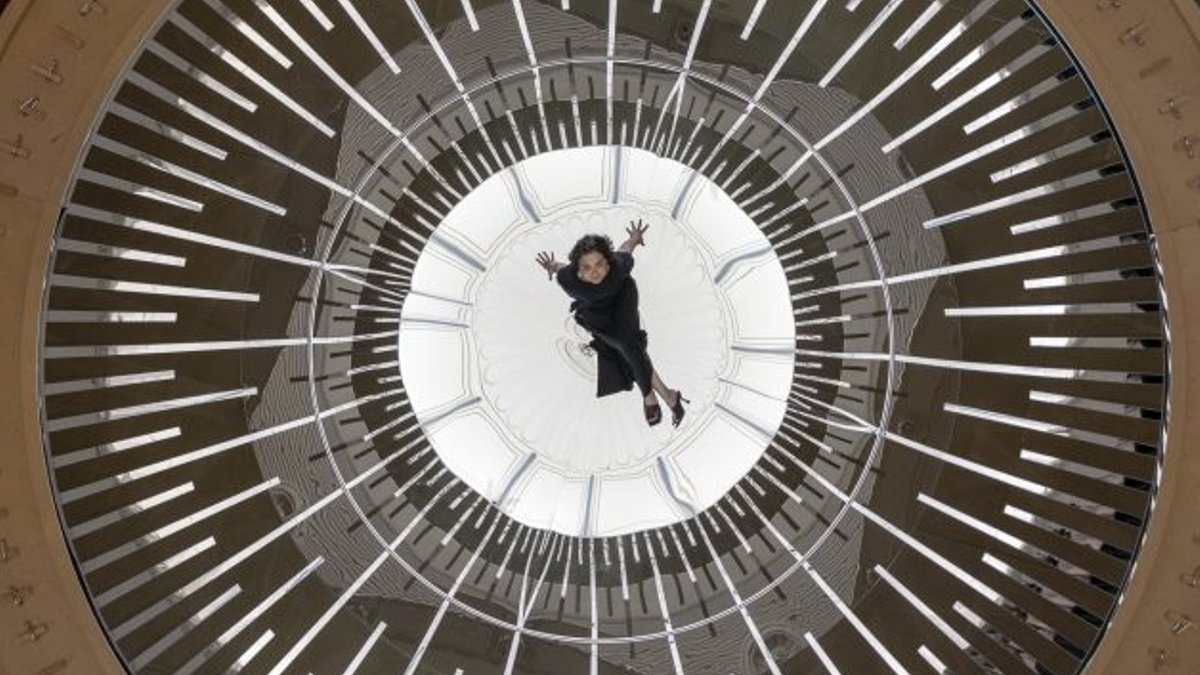
The Bank of England Museum presents an installation by award-winning designer Melek Zeynep Bulut, merging art, architecture, and alchemy under its historic dome in London’s financial district.
A space where perception shifts
The exhibition, titled The Living Room: Alchemy, runs until 3 July 2026. It immerses visitors in a sensory environment shaped by reflective surfaces, sound, and geometric forms. Bulut’s design draws from the Gestalt Principles of Perception—the idea that the mind reconstructs reality rather than perceiving it objectively—and the esoteric concept of the Philosopher’s Stone, a symbol of transformation in alchemy.
As visitors move through the space, their interactions change the environment in real time. Mirrors break reflections into fragments, while soundscapes shift with movement, creating fleeting distortions. Bulut describes the experience as one that “exists solely within the visitor’s perception,” highlighting its ephemeral quality.
The museum, home to one of the world’s largest gold vaults holding 400,000 gold bars, offers an unexpected setting. Its grand dome looms above, and Bulut’s design subtly echoes its architecture, linking the institution’s financial history with abstract artistic exploration.
Art as a living experiment
Known for experimental spatial interventions, Bulut frames the installation as a “living room”—a place where the body and knowledge meet. The work doesn’t just fill the museum; it examines how architecture influences understanding. By focusing on perception rather than permanence, she challenges traditional ideas of function in design, proposing that meaning emerges through interaction between viewer and space.
Related: Liaigre Refines Spa at Hôtel Costes
This balance between stability and change reflects broader discussions in contemporary architecture. Buildings are often seen as fixed, but Bulut’s work suggests they can be dynamic, even performative. The installation depends on visitors to complete it—without their presence, the art remains unfinished.
For many, the experience offers a brief departure from the museum’s usual economic and historical themes. The gold reserves, symbols of enduring value, contrast with the installation’s focus on impermanence. Yet both explore transformation—one through alchemy, the other through financial systems.
Part of a larger conversation
The exhibition is part of the London Festival of Architecture 2026, a citywide event examining how design shapes urban life. Bulut’s work stands out for its intimacy; while many festival installations engage with public space, The Living Room: Alchemy operates at a human scale, requiring active participation rather than passive observation.
The Bank of England Museum’s location adds depth. The building represents institutional power, yet Bulut’s design introduces unpredictability. It demonstrates how even rigid structures can allow moments of play—and how perception, like gold, can be endlessly shaped.
Admission to the museum and exhibition is free, though timed tickets are recommended due to limited capacity. The museum opens Monday to Friday, with extended hours on select evenings.