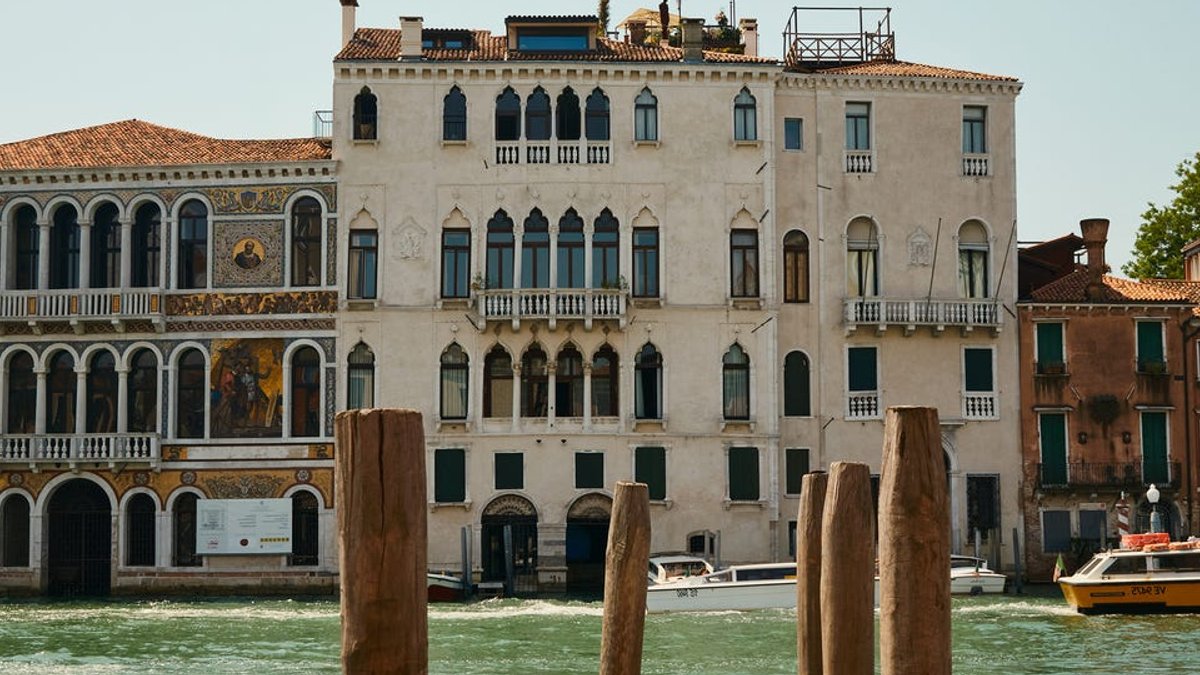
A 16th-century Venetian palazzo overlooking the Grand Canal has undergone a meticulous renovation by Studio Peregalli Sartori. Led by architect Laura Sartori Rimini and philosopher Roberto Peregalli, the project upholds their core principle: maintaining the building’s original character while integrating contemporary functionality. The transformation spans the Portego, a grand reception gallery linking garden rooms to canal vistas, alongside a Carlo Scarpa–designed library, kitchen, bedrooms, and a chapel.
The client, an American entrepreneur and art collector, initially envisioned filling the space with Russian Constructivist artworks. After seeing the restoration, however, he reversed course. “He said, ‘No, I like this,’” he told Sartori Rimini. “I don’t feel the need to fill the place with all of my things. I like these very Venetian ideas of life in the 18th century.” The decision reflected a deeper appreciation for the palazzo’s historical essence.
Preserving the Romantic Atmosphere
Original decorative elements—frescoes, silk wall hangings, and frescoed ceilings, were cleaned and preserved rather than replaced. “The silk on the walls or the frescoes were a little bit ruined, we tried to clean and restore them and keep as much as possible as it was before,” Sartori Rimini explained. “It was about emphasizing, enlightening what was existing, to give back this atmosphere of the palazzo.” She describes that mood as “romantic, a bit metaphysical”, comparing it to a still-life painting. Modern necessities like televisions, gym equipment, and updated bathrooms remain discreetly integrated, their presence inferred only through practical use.
The kitchen exemplifies this duality, featuring a De Manincor stove and Carrara marble countertop alongside 19th-century English wallpaper and seminato Veneziano terrazzo floors. The owner, who frequently cooks for guests, keeps copper pots hanging within reach. A Steinway grand piano in the Portego anchors the space, harmonizing historical weight with modern elegance.
The palazzo’s walls bear silent witness to its layered past. In the portico, a terrazzo floor displays carved words: “this was a bomb”, a remnant of Napoleon’s 1805 conquest. The Carlo Scarpa library, added in the 1960s, was preserved with minimal alterations, a new panel of antique English Deco wallpaper and a bronze ceiling grid refreshing its appearance without disrupting its original design.
Restoring Historical Layers and Detail
The chapel’s walls, where the silk or frescoes were a little ruined, were cleaned and restored. “Most of the work has been done by the restorers, the painters,” Sartori Rimini noted. This philosophy extends to the dining room, where original walls were stripped of 1960s-era paint to expose their authentic hues. For intimate evenings, the owner uses a 19th-century French mahogany table in the Portego, set with Fortuny fabric and paired with rattan chairs cushioned in the same fabric, surrounded by ficus and banana trees. The space evokes a conservatory, with canal views flooding through original windows.
Venice’s delicate preservation requirements influenced every design choice. “Frank Lloyd Wright once made a project for a rich client that he wanted to build on the Grand Canal, but they didn’t allow him to do it,” Sartori Rimini observed. The studio’s custom copper and lycra lampshades mimic the play of light on water, while guest bedrooms feature restored original details. This approach reflects Venice’s inherent duality: a city where Napoleon’s artillery and Monet’s environments coexist, demanding that modern life coexist with history without erasing it.
The owner’s decision to live “as a Venetian”—as a custodian rather than a collector, embodies this balance. “Respect, respect,” Sartori Rimini emphasizes. “Venice is fragile.” The palazzo now stands as a living dialogue between past and present. Frescoes silently observe dinner gatherings, while the bomb-scarred floor serves as a reminder of resilience. In quiet moments, tea by the canal, the piano’s soft notes, the building feels alive, its history not as a static backdrop but as an active participant in daily life.