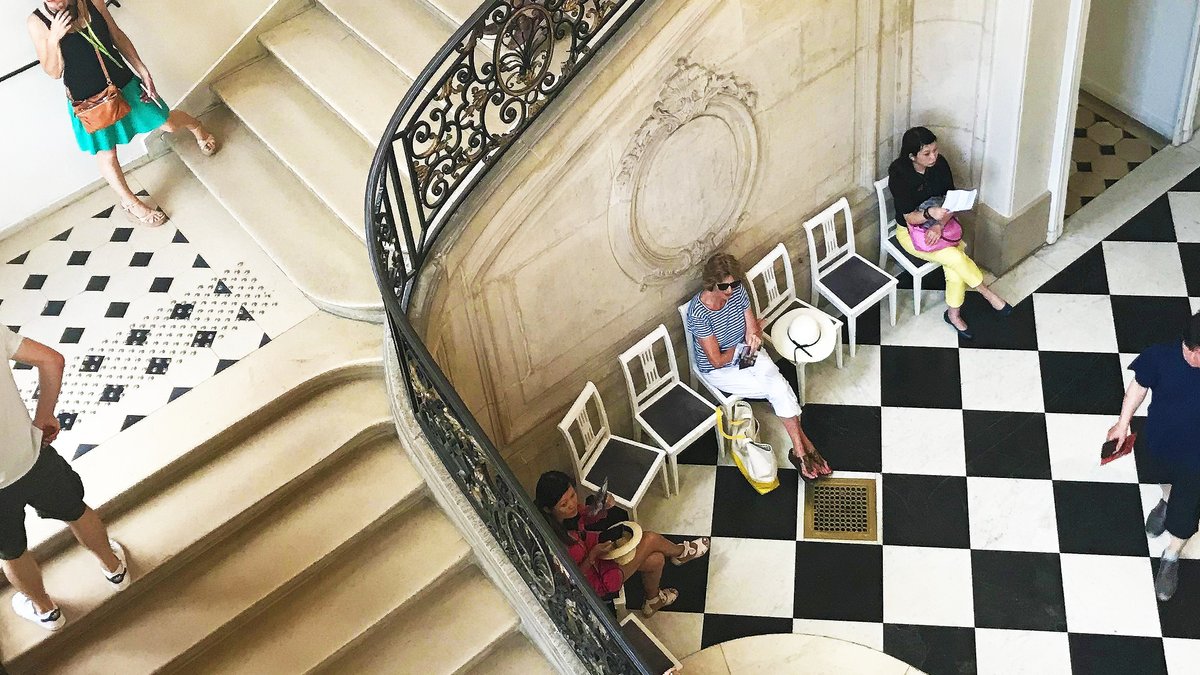
French architects and French-trained designers used a specific technique to smooth out the handrail on a standard quarter-turn stair, creating a more natural walking line without using extra floorplan space. This design, known as the “French landing,” evolved from the earlier method of extending the landing one tread depth, which solves the problem of stacked risers by providing room for a smoother transition. The result is a consistent rise and run that prevents the need for users to change their hand position or stride on the turn, addressing a common safety issue on L-shaped stairs.
A Safer, More Elegant Solution
Quarter-turn stairs force the handrail to jump in elevation at the inside corner, often requiring easings or goosenecks to maintain a consistent height above the treads. The building code attempts to mitigate this by requiring a walkline distance of at least 19 inches and a minimum tread depth of 10 inches, but these standards still result in a break in stride and a change in hand position.
This disruption contributes to accidents on these stairs, though falls are generally less severe than on straight runs because the distance is shorter. A French landing eliminates these abrupt changes by using curved treads and landings that extend toward the guardrail, allowing the handrail to follow a subtle S-curve in elevation rather than jumping.
The technique was notably employed by Richard Morris Hunt, the first American admitted to the École des Beaux-Arts in Paris and a founder of the American Institute of Architects. Hunt used French landings in many of his residential designs, including the staircase at The Breakers in Newport, Rhode Island. In that structure, the handrail maintains a gradual ease in elevation, allowing the user to keep their hand on the rail throughout the turn. The design also ensures a consistent stride along the walkline, which is defined by code as a line 12 inches from the guardrail. This approach creates a stair that feels like a circular staircase without the complexity of a true winding stair.
Read Also: Pregnancy, Delivery, and Beyond: A Guide to Informed Maternity Care Decisions
A Design for the Walkline
The curved treads and landing extend toward the guardrail to create a walkline that matches the rise and run of the surrounding flights. This geometry ensures that a person following the line 12 inches from the wall can maintain an even stride without stepping awkwardly. The design meets code requirements by providing a minimum tread depth of six inches at the guardrail.
A Historical Precedent
Richard Morris Hunt employed this method in many of his designs. He used French landings in the staircases of The Breakers and other Gilded Age mansions.
Historical Examples of the Style
He was a prolific designer of monuments, churches, and public buildings throughout the United States during the late 19th century. Hunt is especially known for the elaborate mansions he built for wealthy families, setting the standard for residential design until Modernism began to take hold at the turn of the last century.