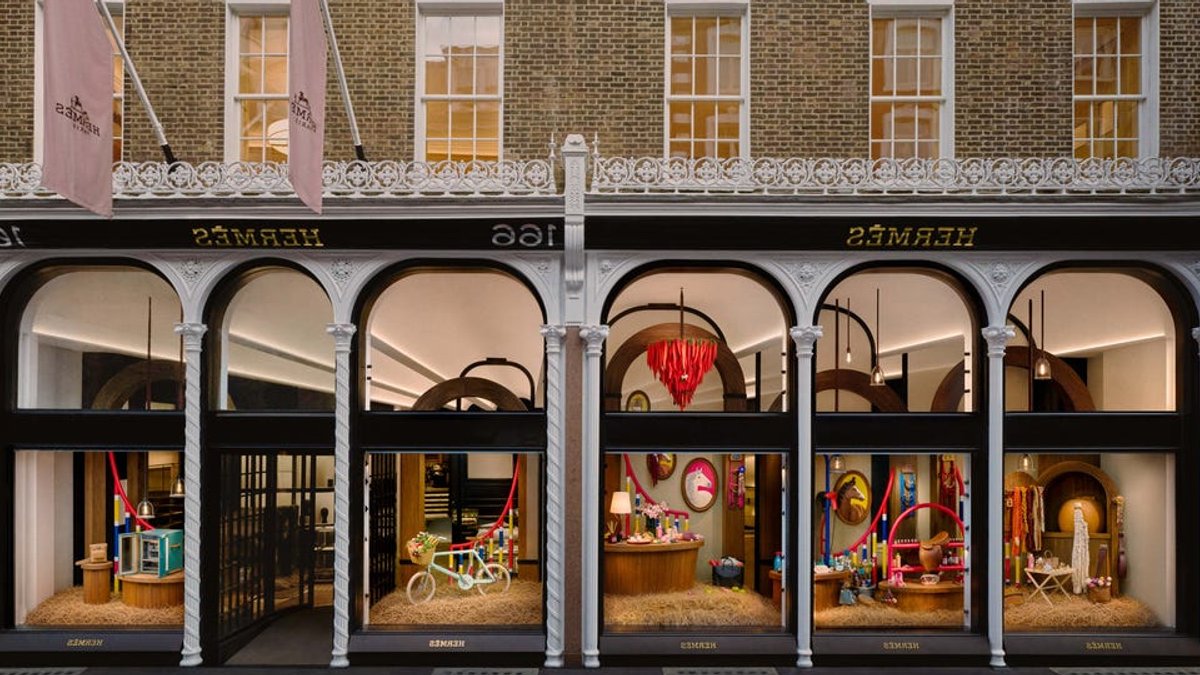
Hermès’s new London flagship store is a sign of the brand’s commitment to honoring the spirit of place. Occupying six Grade II–listed buildings on New Bond Street, the store blends history with modern luxury, reflecting the company’s $19 billion in revenues last year. The façade itself is a sign of the brand’s meticulous attention to detail, preserving the architectural integrity of the historic structures while seamlessly integrating contemporary elements. Inside, the interplay of old and new is further emphasized through the use of materials like reclaimed wood, bespoke metals, and artisanal textiles, all crafted to enhance the building’s original character.
A Roman Legacy in London
The story of London begins with the Romans, who brought not only engineering prowess but also the concept of genius loci—the spirit of a place. This idea has influenced environment design, poetry, and architectural theory over centuries. For Pierre-Alexis Dumas, Hermès’s artistic director and a sixth-generation descendant of the founder, this philosophy is central to the brand’s identity.
Dumas often reflects on how the Romans’ legacy extends beyond physical structures, shaping the cultural and spiritual essence of the city. Their introduction of Londinium as a busy hub of trade and culture laid the groundwork for London’s enduring global influence. The concept of genius loci, deeply embedded in Roman thought, resonates with Dumas’s vision for Hermès, where each store is designed to capture the unique essence of its location.
“They will all be very different,” Dumas says of Hermès’s 300-plus stores worldwide. This approach is evident in the London flagship, where each of the 55 individually designed rooms pays homage to the building’s Georgian, Victorian, and modern histories. The rooms are not merely retail spaces but immersive environments that tell stories of London’s past, from the opulence of the Georgian era to the industrial innovation of the Victorian age. Dumas emphasizes that this diversity is not just aesthetic but also functional, ensuring that each space feels authentic and rooted in its historical context.
Reviving Historic Spaces
The five-story property, first acquired in 2009, presented unique challenges. Hermès had to decide how to use the interconnected buildings, once partially occupied by Asprey. They chose to maximize retail space, adding two twisting flights to the Support + Partners spiral staircase and raising the skylight. The decision to expand the staircase was not just practical but symbolic, representing the brand’s ascent and its commitment to raising the customer experience. The skylight, now a central feature, floods the space with natural light, enhancing the sense of openness and connectivity between floors.
Restoration efforts included reviving a lost Georgian mosaic and repairing a Victorian-style elevator dormant for 50 years. The team also installed 550 works of art and created a rooftop garden and a private reception space featuring artifacts from the Emile Hermès Collection. The mosaic, discovered during the renovation, was painstakingly restored by artisans using traditional techniques, ensuring its authenticity. The elevator, affectionately named the “Nixon,” was not only repaired but also transformed into a functional piece of art, complete with detailed detailing that nods to its Victorian origins. The rooftop garden, with its carefully curated flora, offers a serene escape, while the private reception space serves as a cultural hub, showcasing rare artifacts that highlight Hermès’s rich heritage.
A Blend of Old and New
Collaborating with the architecture firm RDAI, founded by Dumas’s mother, Hermès ensured each space had a distinct style. This approach contrasts sharply with the homogeneity of many luxury brands today. “We need so much space because we have such large collections now,” Dumas explains, overseeing 16 metiers and their respective creative directors. The collaboration with RDAI was key in achieving a cohesive yet diverse design language, where each room feels like a unique chapter in a larger narrative. The firm’s expertise in blending historical preservation with contemporary innovation ensured that the store’s design remained both timeless and forward-thinking.
The store’s design reflects Dumas’s belief in constant reinvention. “Hermès is a house where we can never take ourselves for granted,” he says. This philosophy extends to his team: “You don’t have any ideas? I tell them, ‘Stop working, go home, read a book, go and see a movie, go see a show, walk around the block, change your mind, and go and rest and come back with a fresh eye.’” Dumas’s emphasis on creativity and perspective-shifting shows his belief that innovation stems from a deep engagement with the world. He encourages his team to draw inspiration from diverse sources, from art and literature to nature and travel, supporting a culture of curiosity and exploration.
A Legacy Continues
The London flagship is more than a store; it’s a celebration of history and craftsmanship. From the Roman roots of the city to the Georgian and Victorian eras, the building’s past is woven into its present. This project, completed in 2026, marks a significant milestone for Hermès, showcasing its ability to honor tradition while adopting innovation. The store serves as a living museum, where customers can experience the evolution of London’s architectural and cultural heritage firsthand. Each detail, from the restored mosaic to the rooftop garden, tells a story of continuity and transformation.