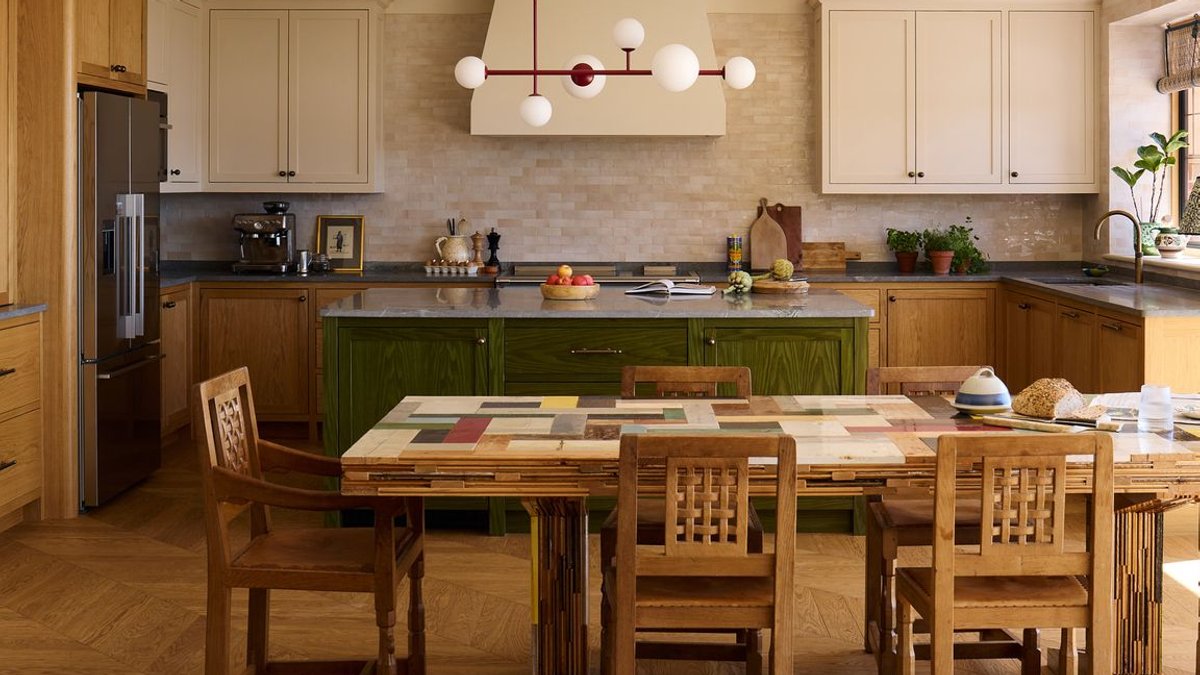
A family relocating from London to Surrey Hills encountered a familiar issue: their new home, an Arts & Crafts-style house, required a balance between preserving its heritage and adapting it for modern living. The original extension, constructed by an architect and his wife over half a century earlier, had become a fragmented space that obscured the property’s panoramic views. The solution involved a complete rebuild, working with architects Mitchell Evans and designers Pringle & Pringle to create a functional yet historically respectful living area for their active lifestyle.
The project centered on harmonizing old and new elements without erasing the house’s past. “Every intervention was tested against how it would feel in another hundred years, not just today,” she stated.
The clients—a physician and a corporate executive—had distinct tastes. The mother, raised in the 1970s, liked the retro look and was into post-war furniture, though pink was a no-no. The design team responded by opening up key areas, such as the kitchen and entrance hall, while introducing contemporary decor. Even the traditional dark wood beams, characteristic of Arts & Crafts homes, were sandblasted to brighten the interiors.
Balancing heritage with practical bathroom restoration
Preserving heritage extended beyond visual appeal, shaping the project’s limitations. For instance, the original Delft tiles in the guest bathroom were kept despite the room’s poor layout. After removing the old bath and carpet, the team sourced antique tiles to fill gaps, transforming the space into one of the house’s most striking areas.
Other original features were restored rather than replaced. Warped Arts & Crafts doors were replicated instead of discarded, and damaged spindles on the Guildhall staircase were repaired. “There was a real desire to lead with craftsmanship right from the beginning,” Sophie said. This philosophy extended to material choices, such as the kitchen’s unpainted natural timber, which the client wanted to retain for its authenticity and connection to the house’s heritage.
The extension also addressed practical concerns. A long, dim hallway and a separate games room were consolidated into a bright, open space with direct garden access. The original side entrance, a charming but impractical door, was preserved as a “time capsule,” while a new grand entrance hall, positioned near the driveway, now provides a welcoming and logical entry point.
Light and materials redefine modern heritage living
Light became a defining aspect of the design. Sophie highlighted how it influences the atmosphere of each space, using color and fabric to enhance the experience. In the living room, earthy browns and greens from Schumacher Khantau Tree fabric created warmth, while the kitchen’s 7.5-meter sliding window offered uninterrupted views of the Surrey Hills. The use of Svenskt Tenn fabrics and a Piet Hein Eek table, crafted from layered scrap wood, further reflected the clients’ values of sustainability and retro influences.
Structural updates were essential to future-proof the home. Rewiring and replumbing were carried out to meet current safety standards, though the team ensured these changes remained discreet, preserving the house’s original character. The decision to demolish the old extension, despite its thoughtful design, stemmed from its impracticality. “The previous extension was so sympathetic that it was almost impossible to tell where the old house met the new one,” Sophie explained, “but it was a bit of a warren internally, and it wasn’t maximising the incredible views that stretched along the whole length of the property.” The rebuild focused on clarity, opening up key spaces and introducing a freshness through the decor.
The project’s success hinged on materials and craftsmanship. The kitchen’s unpainted timber, chosen for its longevity, now bears a natural patina, contrasting with the high-gloss finishes often favored in modern designs. Similarly, the restored Guildhall staircase spindles and the replicated Arts & Crafts doors reflected a commitment to preservation over replacement. Even subtle touches, like the bespoke straw marquetry top on the Orford table, created by artist Kim Jordan, blended heritage with contemporary artistry. These elements, Sophie observed, ensure the home feels “infused with history” rather than static.